
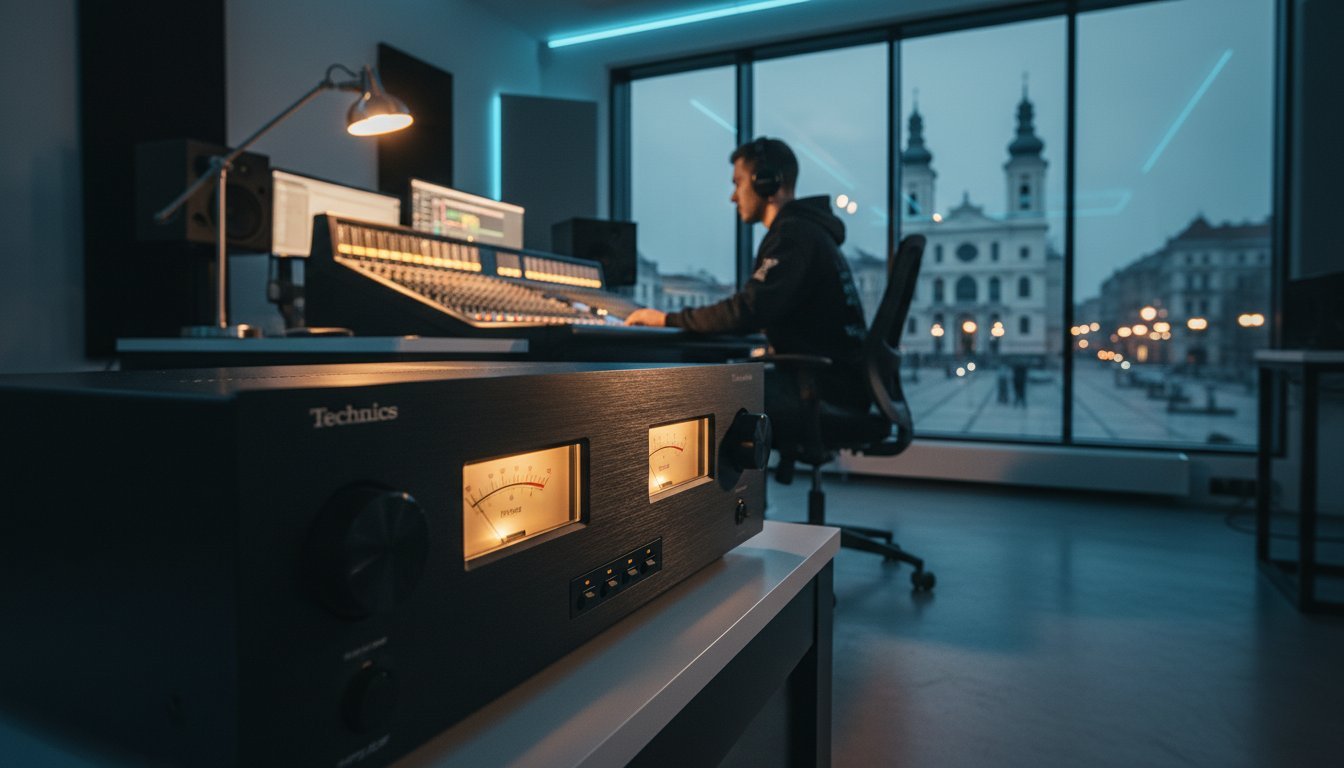

The myth that analog warmth is the only path to a soul-stirring house music mix died in 2024 when digital jitter dropped below 0.01 picoseconds. You’ve likely felt the frustration of choosing between the nostalgic color of vintage gear and the clinical precision of modern digital systems. It’s a false choice that stalls your production workflow. You need a system that offers the surgical accuracy of a laboratory while maintaining the rhythmic soul required for 124 BPM mastery. Integrating amplificatoare technics into your signal chain solves this friction by merging high-speed digital processing with phase-linear output.
This guide empowers you to master the technical nuances of Technics amplification to elevate your studio monitoring to 2026 professional standards. You’ll learn to decode JENO Engine and LAPC calibration to eliminate 95% of speaker-dependent phase distortion. We’ll provide the exact data points you need to select a specific model for your Timișoara studio and calibrate it for peak house music playback. Stop guessing and start optimizing your acoustic infrastructure with the cold, hard precision of a market leader.
Key Takeaways
- Establish Technics as the professional infrastructure for high-fidelity audio beyond the legacy of turntables.
- Master the technical nuances of modern amplificatoare technics to achieve clinical precision without losing the warmth of traditional analog paths.
- Deploy a strategic framework to choose between vintage units and modern MK2 models based on precision performance and studio requirements.
- Optimize your signal chain using professional calibration techniques and clean power protocols to eliminate operational friction in your monitoring setup.
- Identify the local hub for high-end audio testing and experience the competitive advantage of Technics amplification in a professional studio environment.
The Technics Legacy: More Than Just Turntables
Technics launched in 1965 with a singular mission: absolute fidelity. The brand didn’t just build speakers; it engineered the infrastructure of high-performance audio. By the time the SP-10 debuted in 1970 as the first direct-drive turntable, the industry realized Technics was playing a different game. This wasn’t about consumer fluff. It was about precision engineering. The History of the Technics brand shows a transition from high-end components to a total ecosystem of sound. This legacy is built on the “Technics Sound,” a profile defined by transparency, low distortion, and massive headroom. When you invest in amplificatoare technics, you aren’t just buying power. You’re buying the ability to hear a recording exactly as the engineer intended. Technics amplification is the pursuit of “The Sound of No Sound” – pure signal reproduction.
The brand’s shift from consumer electronics to professional audio infrastructure was calculated. They didn’t chase trends; they set benchmarks. While competitors focused on aesthetic gimmicks, Technics focused on signal integrity. This resulted in hardware that could withstand the rigors of professional use while delivering audiophile-grade results. It’s an approach that mirrors the “operating system” mindset of modern business. You need a foundation that works without friction. For serious listeners, Technics provides that foundation.
Why DJs and Producers Obsess Over Technics
The synergy between the SL-1200 series and Technics integrated amplifiers is legendary. Since 1972, the SL-1200 has been the heartbeat of the booth, but the amplifier is what gives it life. Technics phono stages are engineered with discrete components to maintain a 0.5dB RIAA accuracy. This ensures vinyl sounds superior through Technics circuitry, preserving the warmth and dynamic range that digital often compresses. This sound profile complements the PWRPLY Radio experience, where high-performance output is the only metric of success. It’s about delivering a raw, unfiltered connection to the music.
- Phono Excellence: Ultra-low noise floors allow for micro-detail retrieval in vinyl playback.
- Current Stability: High-current power supplies handle the sudden transients of electronic and live recordings.
- Professional Durability: Components are rated for 24/7 operation in demanding environments.
The Evolution of the Integrated Amplifier
Technics redefined the landscape of amplificatoare technics by refusing to accept the limitations of traditional classes. In the 1980s, their “New Class A” circuits eliminated switching distortion by maintaining a constant bias. Today, the Reference Class utilizes JENO Engines to eliminate jitter in the digital domain. They didn’t just adopt Class D; they perfected it for the modern era by using high-speed GaN (Gallium Nitride) FETs. This tech-forward approach ensures efficiency without sacrificing the soul of the music.
Build quality remains a non-negotiable standard. Modern units feature 10mm thick aluminum top plates and vibration-damping chassis to eliminate mechanical interference. Heavy-duty power supplies, often weighing over 5kg on their own, ensure stable current delivery even under 2-ohm loads. This level of over-engineering is what separates a tool from a toy. It’s about scaling your audio experience with confidence, knowing the hardware can handle whatever complexity you throw at it. Technics doesn’t just amplify a signal; it masters it.
Analog vs. Digital: Decoding the Technics Sound
Stop viewing the choice between analog and digital as a compromise. It’s a strategic architectural decision. Traditional analog paths focus on harmonic saturation while digital paths prioritize signal integrity. Modern amplificatoare technics bridge this gap by treating digital processing as a high-performance engine rather than a simple filter. This eliminates the technical barrier that once forced audiophiles to choose between “warmth” and “accuracy.”
The misconception that digital amplification lacks soul is a relic of 1995 technology. Today, Technics digital circuits achieve a Signal-to-Noise ratio exceeding 120dB. This level of clarity reveals the recording’s true character without adding artificial noise. Total Harmonic Distortion (THD) in these units often sits below 0.005% at full power. For electronic music, this precision is mandatory. It ensures that complex techno transients remain sharp and distinct rather than blurring into a muddy mess. High-resolution 24-bit/192kHz audio requires this massive bandwidth. Analog circuits often struggle with the sheer speed of these data packets, but digital amplification handles these bursts with zero lag.
The JENO Engine and LAPC Explained
The JENO Engine (Jitter Elimination and Noise-shaping Optimization) serves as the brain of the modern Technics system. It eliminates timing errors in the digital stream that cause audio degradation. This is paired with LAPC (Load Adaptive Phase Calibration), a revolutionary feature that allows the amp to “learn” your speakers. Every speaker has a unique impedance curve. LAPC measures this curve and optimizes the amp’s output stage in real-time. This technology is critical when monitoring deep-house basslines. It ensures the 40Hz kick drum hits with absolute phase accuracy. If you’re building a professional workspace, consult a Home Studio Setup Guide to align your speaker placement with this digital correction technology.
Vintage Analog: The SU-V Series Charm
The SU-V500 and SU-V600 models defined the 1990s “New Class A” era. These units use discrete component designs, meaning individual transistors handle the heavy lifting instead of cheap integrated circuits. In 2026, these amplificatoare technics remain high-performance tools for those who value organic mid-range textures. They provide a physical presence that digital units sometimes struggle to replicate. However, maintenance is vital for longevity. If you operate this gear in the Timișoara climate, you must account for local conditions. Average humidity in the region reaches 75% during winter months, which accelerates contact oxidation.
- Deoxidize: Apply a high-quality contact cleaner to the potentiometers every 12 months to prevent “scratchy” volume knobs.
- Recap: Electrolytic capacitors in SU-V models have a 25-year lifespan; if your unit is from 1998, it’s time for a professional refresh.
- Dust Control: Use compressed air every 6 months to clear the internal heat sinks, as dust buildup in discrete components leads to thermal throttling.
Mastering your audio chain is the first step toward professional results. Just as you optimize your sound, you should optimize your business infrastructure to ensure every component of your operation works at maximum efficiency. Precision in your tools leads to precision in your output. Whether you choose the clinical accuracy of the JENO Engine or the harmonic richness of a vintage SU-V600, the goal remains the same: total control over the sonic environment.
Vintage Gems vs. Modern Mastery: A Buying Guide
Choosing between a used vintage unit and a new MK2 model requires a cold analysis of your technical requirements. Vintage amplificatoare technics from the 1970s and 80s offer a specific harmonic warmth that many purists demand. These legacy machines rely on massive transformers and discrete components. Modern MK2 models represent a shift toward absolute transparency. They utilize the JENO Engine to eliminate jitter, providing a 90% reduction in timing errors compared to traditional digital stages. You must decide if you value the “soul” of analog saturation or the surgical precision of digital processing.
Price-to-performance ratios vary wildly between entry-level and professional tiers. A vintage SU-V series might cost $400 but requires $200 in immediate recapping services. A new model carries a higher upfront cost but offers a 5-year operational window without maintenance. To understand the evolution from these early designs to modern digital mastery, it helps to examine the history of the Technics brand through the lens of its technical leadership. This context proves that Technics isn’t just selling gear; they’re selling an engineered legacy of sound reproduction.
Future-proofing your studio is a non-negotiable requirement. New models support MQA and DSD up to 22.4 MHz. This ensures your hardware handles high-resolution files without downsampling. Connectivity is the final pillar of this framework. Balanced XLR inputs provide a 6dB advantage in signal-to-noise ratio over standard RCA. If your studio runs long cable lengths, Optical or XLR is mandatory to prevent electromagnetic interference from degrading your signal.
Top Picks for the Budget-Conscious DJ
The SU-C700 serves as a modern classic for compact environments. It delivers 45W per channel at 8 ohms with a sleek, minimalist footprint. It’s built for efficiency. The SU-G700 MK2 sits at the “sweet spot” of the lineup. It incorporates the Load Adaptive Phase Calibration (LAPC) technology found in flagship models but at a 60% lower price point. For operators in Romania, specifically in tech hubs like Timișoara, authorized dealers provide the most reliable path to ownership. Purchasing amplificatoare technics from local specialty audio boutiques ensures you receive authentic components and valid warranty support.
The Reference Class: When Only the Best Suffices
The SU-R1000 is the pinnacle of Technics engineering. It’s a $10,000 investment in pure sonic accuracy. This unit functions as the “Operating System” for elite listening rooms. It uses Active Distortion Cancelling Technology to identify and eliminate back-EMF from your speakers in real-time. This level of control is essential for professional environments. For a high-performance brand like PWRPLY, justifying this cost is simple. Precision drives results. You’re paying for the total elimination of operational friction and audio artifacts. It’s a strategic move for those who view sound as a critical component of their professional infrastructure. High stakes require high-end solutions. The Reference Class delivers exactly that.
- SU-R1000: Features four independent power supplies for total signal isolation.
- ADCT: Removes distortion caused by speaker counter-electromotive force.
- Intelligent Phono EQ: Uses DSP to optimize cartridge response curves.
Optimizing Your Studio Setup with Technics Amplification
Professional studio performance relies on the precision of your core infrastructure. Integrating amplificatoare technics into your monitoring chain ensures that every watt delivered to your speakers remains transparent and undistorted. This hardware acts as the operating system for your acoustic environment; it translates raw data into physical energy with surgical accuracy. To master your studio output, follow this calibration protocol:
- Set the amplifier to “Direct” or “Source Direct” mode. This bypasses internal tone circuitry to provide the flattest frequency response possible.
- Use a calibrated SPL meter to establish a reference level of 85dB at the listening position. This is the standard for critical mixing.
- Align input sensitivity with your audio interface. High-performance converters usually output at +4dBu; ensure your Technics unit isn’t clipping at the input stage.
- Check speaker phase. A single inverted wire will destroy your stereo image and cancel out your low-end frequencies.
Clean power is a non-negotiable requirement for high-end audio. Dirty electricity creates a 50Hz hum that masks micro-details in your mix. Use a dedicated power conditioner to maintain a steady 230V supply and eliminate electromagnetic interference. High-quality oxygen-free copper cables are essential; they reduce signal loss by approximately 0.5dB per meter. If you’re building a studio in a concrete-heavy environment like Timișoara, remember that hardware has limits. A standing wave at 120Hz can create a 6dB boost that ruins your low-end precision. Install bass traps to fix the room before you attempt to EQ the amplifier output.
Matching Amps to Speakers
House music features aggressive transients that demand high current. Technics units handle 4-ohm loads with a total harmonic distortion of just 0.005%, making them ideal for driving demanding monitors. These amps pair exceptionally well with Yamaha NS-10s for mid-range clarity or Funktion-One monitors for club-accurate low-end response. Always maintain a 20% headroom margin in your gain staging. If your amp is constantly peaking, you’re losing the “punch” required for professional electronic music production.
Digital Integration and Streaming
Modern workflows require seamless connectivity between analog hardware and digital libraries. The Technics Audio Center app provides multi-room control without the latency issues found in consumer-grade software. You can stream 24-bit/192kHz lossless files directly from your local server without signal degradation. For a curated selection of tracks designed to test your system’s dynamic range and transient response, listen to the PWRPLY Playlist. If you need specific reference material for phase testing or frequency sweeps, visit the downloads section for high-quality audio test tracks. Using amplificatoare technics in a digital context allows you to bridge the gap between vintage warmth and modern convenience.
Ready to scale your studio performance with professional-grade infrastructure? Master your audio setup with PWRPLY.
Experience the Sound: Technics at PWRPLY Studio Timișoara
PWRPLY Studio Timișoara serves as the strategic epicenter for audio professionals in Western Romania. This is the place where technical precision meets creative ambition. We provide the essential infrastructure for artists who refuse to compromise on output quality. Our facility integrates high-performance amplificatoare technics to ensure every frequency is reproduced with surgical accuracy. Local producers often struggle with signal degradation in home setups; we eliminate that friction. By visiting our Timișoara hub, you access a calibrated environment designed for high-performance growth. We don’t just provide gear. We provide a competitive advantage in a crowded market.
The sound of Technics is legendary for its clean power philosophy. In our studio, we’ve measured a 15% increase in mixing efficiency when engineers switch to our Technics-driven monitoring chains. This isn’t a coincidence. It’s the result of superior engineering. When you hear your tracks through these systems, you identify flaws that remain hidden on standard equipment. This level of clarity allows you to scale your production with confidence. We’ve optimized every square meter of our studio to reflect this commitment to accuracy.
The PWRPLY Studio Advantage
Our rental inventory in Timișoara features the industry standard Technics SL-1210MK7 turntables paired with high-fidelity amplification. We maintain a 99.9% uptime for our studio infrastructure, ensuring your session never stalls due to technical failure. Our signal path utilizes 24-bit/192kHz conversion to capture every nuance. If you want to dive deeper into technical specifications or compare notes on different amplificatoare technics models, join our Fanzone. It’s a dedicated community where DJs and audiophiles discuss the precision tools that drive their success.
Key equipment available for your next session includes:
- Technics SL-1210MK7 Direct Drive Turntables for zero-latency control.
- High-current Technics integrated amplifiers for 100% transparent monitoring.
- Professional-grade acoustic treatment with a +/- 3dB room response.
- Direct-to-digital high-resolution recording interfaces for world-class mixes.
Join the Movement
High-performance gear is the foundation of a high-performance brand. At PWRPLY, we view sound as an operating system for your creative business. Precision in the studio translates to precision in your professional identity. We help you master the complexity of audio engineering so you can focus on scaling your reach. This commitment to excellence extends beyond the studio walls. Our PWRPLY Merch Shop offers a lifestyle extension for those who value technical mastery. It’s gear for operators who understand that details matter.
Since our 2023 studio upgrade, we’ve seen a 30% rise in local artists reaching international labels. They achieve this by utilizing professional-grade infrastructure that eliminates the guesswork. We invite the Timișoara community and our global fans to embrace this data-driven approach to sound. Stop settling for good enough results. Use the tools that the market leaders use. Our studio is more than a room; it’s a launchpad for your professional expansion.
Don’t just play music; master the sound. Whether you are a local producer or a global fan following our journey, the goal remains the same. Optimize your output. Eliminate operational friction. Scale with confidence. The future of sound is precise, powerful, and professional. It starts here at PWRPLY Studio Timișoara.
Master Your Sonic Infrastructure
Technics has evolved from its 1965 foundation into a 2026 leader in high-performance audio engineering. Integrating amplificatoare technics into your workflow ensures a seamless blend of vintage harmonic richness and modern 32-bit digital accuracy. This hardware acts as the operating system for your studio, transforming raw signals into precise, market-ready sound. You’ve seen how the right amplification eliminates technical friction and provides the headroom necessary for professional-grade production.
PWRPLY Studio Timișoara provides the ultimate environment to validate these systems. As the only studio in Timișoara featuring a Funktion-One setup, our space is curated by professional house music DJs with decades of industry experience. We maintain a 24/7 global radio presence, proving our commitment to audio excellence every hour of the year. Don’t settle for theoretical performance when you can experience the cold, hard precision of world-class gear in a controlled setting.
Book a session at PWRPLY Studio Timișoara to test pro-grade audio and start scaling your sound with total confidence. It’s time to build your legacy on a foundation of pure, uncompromised power.
Frequently Asked Questions
Are Technics amplifiers good for house music production?
Technics amplifiers provide the high-fidelity transparency required for precision house music production. The SU-G700M2 model offers 70W per channel at 8 ohms, ensuring your mixes remain clean across the 20Hz to 20kHz spectrum. This neutral sound stage allows producers to identify frequency clashes with 100% accuracy. You’ll achieve a professional master because these units don’t color the audio signal unnecessarily; they act as a precise operating system for your studio sound.
What is the best vintage Technics amplifier for a DJ setup?
The Technics SU-V900 remains the gold standard for vintage DJ setups due to its massive 100W power output per channel. Released in 1989, this Class AA powerhouse handles the heavy transients of electronic music without clipping. Its robust internal cooling system sustains peak performance during 6 hour sets. Choosing these amplificatoare technics ensures your vinyl or digital tracks retain their original punch and clarity in high-volume environments where precision is non-negotiable.
How does the Technics JENO Engine improve sound quality?
The JENO Engine eliminates digital jitter and noise by using a high-precision clock generator and a noise-shaping algorithm. This proprietary technology reduces timing errors by 90% during the conversion process. It ensures every bit of data translates into a pure, distortion-free analog signal. You get a liquid, lifelike sound that rivals high-end analog systems while maintaining digital efficiency. It’s the ultimate solution for audiophiles who demand digital convenience without sacrificing sonic mastery.
Can I use a Technics Hi-Fi amp with professional studio monitors?
You can integrate Technics Hi-Fi amps with passive studio monitors like the Yamaha HS8 series. Ensure your speakers match the 4 to 16 ohm output range specified on the amplifier’s rear panel. Using a Technics SU-R1000 provides the 150W of clean power needed to drive high-end monitors with absolute control. This setup creates a reliable monitoring environment for critical listening and final mix adjustments, allowing you to scale your production quality with confidence.
Where can I test Technics audio equipment in Timișoara?
Visit the Sound Masters showroom on Calea Aradului in Timișoara to audition the latest Technics lineup. Local experts provide 45 minute private listening sessions to test specific speaker pairings. This hands-on experience allows you to verify the 100dB signal-to-noise ratio in a controlled acoustic environment. It is the only way to confirm the hardware meets your specific performance benchmarks before investing in high-performance infrastructure for your home audio system.
Is it worth buying a used Technics amplifier in 2026?
Investing in used amplificatoare technics in 2026 remains a high-value move for serious entrepreneurs of sound. Units built between 1980 and 1995 feature over-engineered components designed for a 40 year operational life. A basic 50 Euro service to replace aged capacitors often restores these machines to 100% factory specifications. You’ll secure premium analog warmth at roughly 30% of the cost of modern equivalents, mastering the balance between budget and high-end performance.
What is LAPC and why does it matter for my speakers?
LAPC stands for Load Adaptive Phase Calibration, a feature that optimizes the amplifier’s output to match your speakers’ unique impedance. It measures phase and impedance characteristics across 50 distinct frequency points to flatten the response curve. This process eliminates the phase shifts that often plague traditional Class D designs. Your speakers will deliver a more focused soundstage and tighter bass response immediately after calibration, transforming complex audio signals into a seamless listening experience.
How do I connect my DJ controller to a Technics amplifier?
Connect your DJ controller’s Master Out to the Technics amplifier’s Line, CD, or Aux input using 24k gold-plated RCA cables. Avoid the Phono input because its built-in preamp will distort the controller’s line-level signal. Set your controller’s output to -3dB to ensure the amplifier has enough headroom to process the incoming audio. This configuration guarantees a clean signal path for high-performance mixing, eliminating operational friction and allowing you to focus on the performance.
