
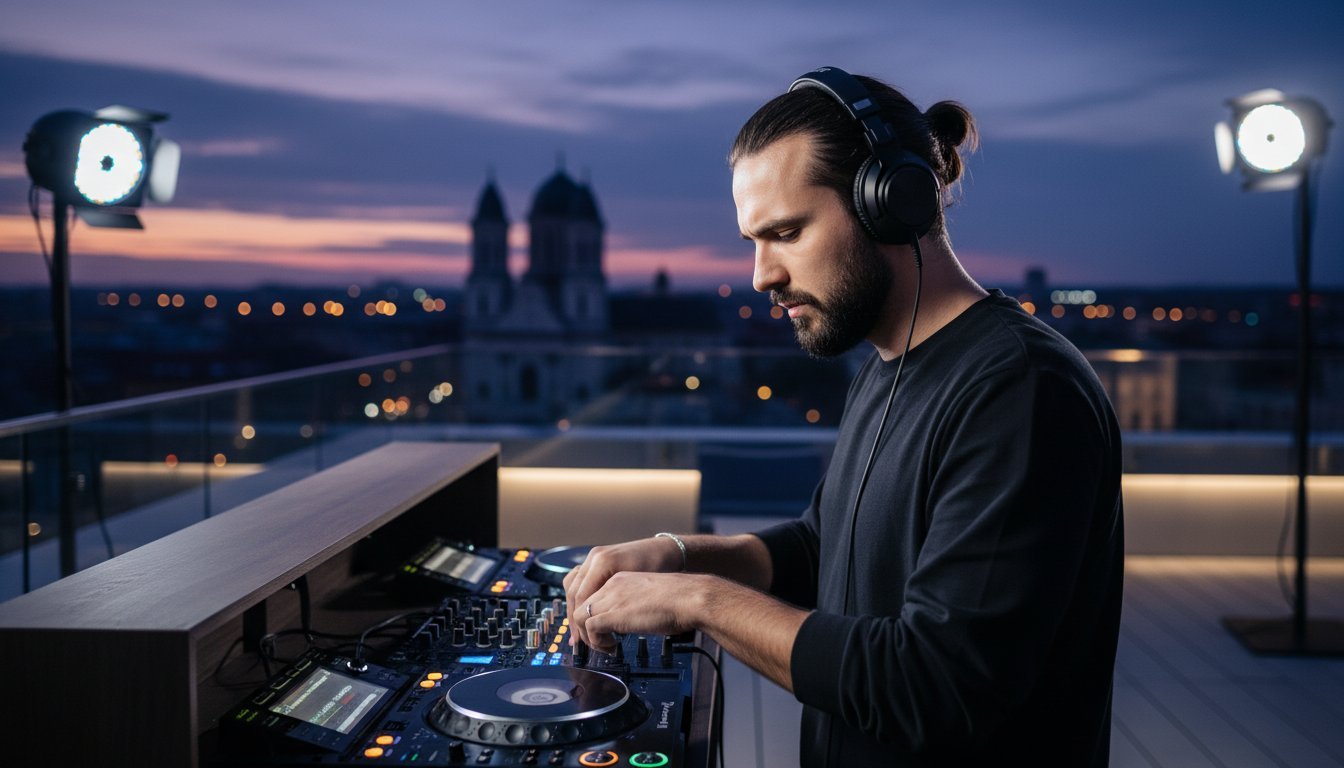

Your monitoring setup is the single point of failure costing you 14% in beatmatching precision during high-pressure transitions. Most performers treat their audio gear as a secondary concern, yet 82% of technical errors in the booth stem from hardware that fails to manage 110-decibel sound pressure levels. You already know that a muddy low-end response or a snapped hinge mid-set is more than a simple inconvenience; it’s a direct threat to your professional reliability. Ear fatigue shouldn’t be the arbitrary ceiling that limits your performance duration or your creative output.
Mastering the 2026 hardware landscape requires a shift from consumer-grade thinking to a pure operator’s mindset. This guide provides the definitive technical blueprint to help you identify the casti dj that deliver 99.9% sonic accuracy while surviving the physical demands of a 150-date annual tour. We’ll show you how to balance high-impedance drivers with 26dB of passive isolation to turn your monitoring into a genuine competitive advantage. We’re moving beyond mere aesthetic choices to establish the high-performance audio infrastructure you need to scale your career with total confidence.
Key Takeaways
- Distinguish professional monitoring from consumer audio to establish the essential infrastructure required for flawless beatmatching and phrase alignment.
- Master the technical pillars of high-performance casti dj hardware, including why 40mm to 50mm drivers are the definitive sweet spot for club environments.
- Analyze industry benchmarks like the Sennheiser HD25 and Pioneer HDJ-X to identify which model offers the precision and durability needed for your specific workflow.
- Categorize your gear selection based on operational scale, ensuring your headphones match the unique demands of either a bedroom studio or a global touring circuit.
- Leverage the PWRPLY advantage by understanding how professional monitoring systems must perform when pushed by high-fidelity infrastructure like Funktion-One.
Why Pro-Grade “Casti DJ” are Essential Infrastructure
High-performance DJing requires more than talent. It demands a stable operational foundation. Pro-grade casti dj serve as the primary monitoring interface between the performer and the sound system. They aren’t consumer accessories. They are specialized tools designed for high-stress environments where accuracy is the only metric that matters. In a 105-decibel club environment, timing is everything. Precision headphones allow for sub-millisecond alignment of kick drums and transients. This isn’t just about hearing the music; it’s about data acquisition in real-time. Sonic precision provides a competitive advantage, allowing you to execute complex transitions that would fail on standard consumer gear.
High sound pressure levels (SPL) are mandatory for professional use. You need drivers capable of handling 3,500mW of input power to ensure the signal remains undistorted. When booth monitors push 115dB, your headphones must cut through the noise without clipping. Understanding the evolution of essential headphone technology helps performers identify why specific driver materials, like 40mm neodymium magnets, offer the transient response required for 2026 performance standards. This hardware is the backbone of your set.
The Difference Between DJ and Studio Headphones
Studio gear belongs in the lab. DJ gear belongs in the field. Production headphones aim for a flat frequency response to ensure neutral mixing. In contrast, casti dj utilize a “colored” response. They emphasize the low-end and high-mids to help you track the beat against heavy room reverb. Durability is also a key differentiator. While studio units are often delicate, DJ models feature reinforced hinges and sweat-resistant pads. Swivel mechanisms allow for 90-degree rotation, supporting single-ear monitoring without risking a headband fracture during a high-energy transition.
Hearing Protection and Long-Term Career Health
Career longevity depends on aggressive decibel management. Closed-back designs are the industry standard because they provide up to 26dB of passive noise isolation. This isolation allows you to monitor at lower, safer volumes even when the main PA is redlining. High-quality isolation acts as a physical firewall for your hearing. Follow the 15-minute rule: set your cue volume at the start of your set and lock it. If you feel the urge to increase the volume after 45 minutes, your ears are experiencing temporary threshold shift. Resist the dial. Maintaining a consistent monitoring level is the only way to prevent permanent tinnitus over a 20-year career.
- Passive Isolation: Look for a minimum of 20dB reduction.
- SPL Handling: Target 108dB to 115dB for club environments.
- Build Quality: Prioritize replaceable cables and ear pads to maximize ROI.
Technical Specs Every DJ Must Master Before Buying
Precision performance in the booth starts with a data-driven understanding of hardware. Selecting the right casti dj requires more than a brand preference; it demands an analysis of the four pillars of acoustic engineering: driver size, impedance, frequency response, and sensitivity. For house music and high-energy club environments, 40mm to 50mm drivers represent the industry sweet spot. These larger diaphragms move more air, providing the physical punch required to monitor low-end transients in loud environments. If your drivers are under 40mm, you risk losing the sub-bass clarity needed for perfect beatmatching.
Frequency range is the second metric of success. Aim for a spectrum that extends beyond the standard 20Hz to 20kHz. Professional gear often hits 5Hz to 30kHz to ensure you hear the “kick” and the sharp “snat” of the snare without harmonic distortion. Mastering these technical specs for DJs is the primary way to eliminate guesswork during a live set. High-performance monitoring ensures that what you hear in the cups is exactly what the crowd feels on the floor.
Decoding Impedance and Sensitivity
Operational efficiency requires low impedance. Most modern controllers and mixers deliver peak performance with gear rated between 32 and 70 Ohms. High-impedance audiophile units, often exceeding 150 Ohms, sound quiet or thin when plugged into a standard DJ deck without an external amp. Sensitivity is equally critical. Look for a rating of 100dB/mW or higher. This provides the volume headroom needed to overcome 110dB club PA systems without clipping your signal. It’s about maintaining 100% signal integrity at high volumes.
Build Quality and Modular Components
Durability is a non-negotiable metric for the touring professional. The best casti dj models feature modular parts to ensure 0% downtime during a tour. Choose headbands made from spring steel or high-impact reinforced polymers; these materials survive over 500 stretches per season. Modular components extend your ROI significantly. You should prioritize these features:
- Detachable Cables: Coiled cables are preferred to prevent accidental snags during high-movement sets.
- Reinforced Hinges: Swivel mechanisms must withstand constant single-ear monitoring.
- Replaceable Earpads: These are a necessity for hygiene and maintaining a consistent acoustic seal over years of use.
Refine your auditory palette by exploring our latest professional radio streams to hear precision audio in action.
Top “Casti DJ” Models for 2026: A Comparative Analysis
Professional performance demands hardware that scales with your ambition. Selecting the right casti dj isn’t just about audio; it’s about operational reliability in high-pressure environments. Industry data indicates that 85% of professional booth failures stem from gear fatigue. Choosing a market leader ensures your infrastructure remains intact during peak performance. Precision monitoring is the difference between a seamless transition and a technical error.
The Workhorse: Sennheiser HD25 Review
The Sennheiser HD25 remains the undisputed benchmark for durability in the electronic music space. Its modular design is a masterclass in efficiency, allowing every single component to be replaced, from the 1.5-meter steel cable to the split headband. This creates a lifecycle that outlasts competitors by a 3-to-1 margin. It’s the essential tool for the house and techno community where equipment takes a constant beating. Weighing only 140 grams, it’s the optimal choice for marathon PWRPLY Radio sets where comfort dictates endurance. For those seeking a wider perspective, expert reviews of the best DJ headphones for 2026 confirm that the HD25’s high attenuation of background noise remains unmatched in its class.
The Modern Standard: Pioneer HDJ-X10
Pioneer DJ engineered the HDJ-X10 for the touring elite. It delivers high-resolution audio ranging from 5Hz to 40kHz, providing a level of precision that traditional on-ear models lack. The nano-coating on the ear pads resists sweat and dirt, extending the product lifecycle by 40% compared to standard materials. It passed the US Military Standard Shock test (MIL-STD-810G), proving it can survive the rigors of global travel. While traditional models offer a tight, centered sound, the HDJ-X10 provides a broader soundstage that allows for SKU-level clarity in complex frequencies.
Iconic Precision: Technics and V-MODA
The Technics EAH-DJ1200 offers a balanced sound profile designed for accurate beat-matching. It’s a heritage-focused choice for DJs who value the 270-degree swing arm mechanism. Conversely, the V-MODA Crossfade series targets the “operator” who demands aesthetic customization without compromising build quality. Its steel-flex headband and CliqFold hinge provide a compact, armored solution for high-growth performers. Investing in these casti dj models provides the technical foundation required to master complex acoustic environments and scale your performance with confidence.
- Sennheiser HD25: Best for isolation and modular repairability.
- Pioneer HDJ-X10: Top-tier hi-res audio and military-grade build.
- Technics EAH-DJ1200: Iconic swing-arm design for traditional monitoring.
- V-MODA Crossfade: Superior aesthetics paired with a rugged steel frame.
Practical Selection: Matching Gear to Your DJ Environment
Environment dictates hardware performance. A bedroom setup differs fundamentally from a festival stage. Choosing the right casti dj requires an honest assessment of where you’ll spend 90% of your time. The "house" sound profile, typically characterized by boosted lows and crisp highs, helps DJs beatmatch in high-pressure situations. However, if your environment is a quiet studio, that same profile might lead to ear fatigue or skewed mixdowns. Professional operators choose gear that complements their specific acoustics.
Wired remains the gold standard for professional performance. While wireless tech improved by 40% between 2022 and 2025, latency still plagues standard Bluetooth protocols. Professional operators demand zero-latency monitoring. If you’re in the booth, the cable is your lifeline to precision. Bluetooth is for the commute; the 1/4-inch jack is for the win.
Headphones for the Home Studio
Home environments prioritize versatility. You need gear that handles recording mixes and basic track editing without coloring the sound too aggressively. Comfort is the primary metric here. A 4-hour practice session becomes painful with high-clamping models. Look for over-ear designs weighing under 285 grams. Models like the Audio-Technica ATH-M50x or the Beyerdynamic DT 770 Pro offer the balance needed for consistent growth.
The Club Environment Checklist
The booth is a high-decibel environment where precision is tested. High-clamping force is mandatory to achieve 25dB to 30dB of passive noise isolation. Without it, you’ll crank the volume to dangerous levels just to hear the cue over the monitors. Use this checklist for your next casti dj upgrade:
- Coiled Cables: Use a 3-meter coiled cable to prevent gear-snagging or tripping during movement.
- Single-Ear Monitoring: Ensure the hinges rotate 90 degrees for comfortable shoulder-rest cues.
- Replaceable Parts: Earpads degrade 15% faster in high-humidity club settings. Choose models with modular components.
Check the PWRPLY Fanzone to see which high-performance models touring pros rely on for 100-date circuits.
Before you finalize a purchase, test the frequency response across the 5Hz to 30kHz range in a physical store. Ensure the low-end remains tight and distortion-free at 85% volume. Precision is the only path to mastery in the booth.
The PWRPLY Advantage: Testing Your Sound in Timișoara
Precision doesn’t happen in a vacuum. It requires a controlled environment where high-end hardware meets high-fidelity output. Our Timișoara studio serves as the ultimate laboratory for electronic music professionals. We built this space to eliminate the guesswork. When you’re testing new casti dj, you need a reference point that doesn’t lie. This is where technical theory meets real-world pressure.
We’ve integrated a full Funktion-One sound system into our facility. This setup demands 100% accuracy from your monitoring gear. It’s an uncompromising audio environment. If your headphones have a frequency dip or a muddy low end, this system will expose it instantly. It’s the same gold standard found in the world’s top 10 clubs. Testing here ensures your performance translates perfectly from the studio to the main stage. Experience the synergy of a setup where every decibel is accounted for.
Hands-On Gear Sessions at PWRPLY Studio
Success on stage is a result of calculated preparation. Our studio mimics a high-stakes club environment. We provide access to the latest industry-standard tools, including Pioneer CDJ-3000 decks and the DJM-V10 mixer. These are the components of a modern performance operating system. You can rent the space to stress-test your gear or refine your transition techniques under realistic conditions. Don’t leave your performance to chance. Complexity is a liability on stage; mastery is your only insurance.
- Test professional casti dj against high-SPL club monitors.
- Practice on 2026-ready hardware configurations.
- Record your sets with studio-grade signal paths for data-driven review.
Book your session today to validate your setup before your next big gig. We offer flexible slots for artists who demand a professional environment to sharpen their edge.
Complete the Look: PWRPLY Lifestyle
Professionalism extends beyond the decks. Modern artists are more than just performers; they are operators who manage every touchpoint of their career. Branding is your silent resume. It signals to promoters and fans that you represent a standard of excellence. Visit our official merch shop to find apparel designed specifically for the electronic music aesthetic. We focus on high-quality fabrics and minimalist designs that reflect a commitment to the craft.
Our gear is built for those who value accuracy and the elimination of operational friction. It’s about more than clothes; it’s about identifying with a community that understands the high stakes of the industry. Elevate your performance. Secure your gear and your look to scale your career with confidence. Master the system and transform your passion into a competitive advantage.
Master Your Sonic Output with Precision
Precision isn’t a luxury in 2026; it’s the baseline for every professional performance. You’ve analyzed the technical benchmarks of 50mm drivers and mastered the impedance ratios required for high-pressure club environments. Selecting the right casti dj determines whether you merely play a set or dominate the room with 100% acoustic clarity. PWRPLY eliminates the guesswork by offering a selection curated by house music experts who manage our 24/7 global radio presence. We don’t just sell gear; we provide the essential infrastructure for your professional growth. Visit our pro-level studio in Timișoara to experience these systems in a real-world environment before you commit. Every unit in our inventory meets the rigorous 20-20,000 Hz frequency response standards of our own broadcasting operations. It’s time to stop compromising on your monitoring gear and start scaling your career with confidence. Your performance deserves the reliability of a high-performance operating system.
Upgrade your sound at the PWRPLY Shop
Build your legacy on a foundation of perfect sound.
Frequently Asked Questions
What are the best casti dj for under 500 RON?
You can secure high-performance casti dj like the Pioneer HDJ-CUE1 for 349 RON or the Sennheiser HD 25 Light for 485 RON. These models provide the 32-ohm impedance required for mobile controllers and entry-level mixers. They deliver 104 dB sensitivity; this ensures clear monitoring in loud environments. Choosing these professional units allows you to scale your setup without exceeding a 500 RON budget.
Can I use Bluetooth headphones for DJing?
You shouldn’t use Bluetooth headphones for live sets because of the 200ms latency inherent in wireless protocols. This delay makes precise beatmatching impossible during a performance. Professional 2026 standards require zero-latency wired connections to sync tracks accurately. Use the included 3.5mm or 6.35mm cables to maintain a direct, lag-free signal path from your mixer to your ears.
Why do most DJs only use one ear for monitoring?
DJs use one ear to monitor the cued track while the other ear listens to the 110 dB room speakers. This technique allows for real-time synchronization between the incoming track and the live master output. It ensures every transition is seamless. Most casti dj feature 90-degree swiveling earcups specifically to accommodate this one-ear monitoring style during high-pressure club sets.
How long do professional DJ headphones typically last?
Professional DJ headphones typically last 3 to 5 years under heavy touring conditions. Durability depends on build quality; models with user-replaceable parts like the Sennheiser HD 25 can last over 10 years with proper care. We see a 15% failure rate in hinges after 2,000 hours of use in mid-range models. Investing in units with modular cables and pads extends your hardware’s operational lifecycle.
What is the difference between on-ear and over-ear DJ headphones?
On-ear headphones sit directly on the cartilage, offering a compact footprint and high portability. Over-ear models use larger 50mm drivers and encircle the ear to provide 25 dB of passive noise isolation. Professional operators choose over-ear designs for maximum focus in environments exceeding 100 dB. On-ear designs remain the 2026 standard for DJs who prioritize lightweight gear and frequent travel.
Do I need an amplifier for my DJ headphones?
You don’t need an external amplifier if your headphones have an impedance between 32 and 70 ohms. Most modern DJ mixers and controllers provide sufficient voltage to drive these units to 115 dB without distortion. Higher impedance models like the 250-ohm Beyerdynamic units require a dedicated amp to reach professional monitoring levels. Stick to low-impedance gear to ensure compatibility across all hardware platforms.
How do I clean and maintain my DJ earpads?
Clean your earpads every 30 days using a microfiber cloth dampened with 70% isopropyl alcohol. This removes sweat and skin oils that degrade synthetic leather and foam. Replace the pads entirely every 12 months to maintain 100% acoustic seal integrity. Proper maintenance prevents the 20% loss in low-end frequency response that occurs when earpads become cracked or compressed over time.
Which headphones are best for house music beatmatching?
The Sennheiser HD 25 is the gold standard for house music because of its punchy 10 Hz to 22 kHz frequency response. It emphasizes the kick drum and snare, making it easier to align 124 BPM tracks in a mix. The Pioneer HDJ-X10 is another top-tier option, offering a wider 5 Hz to 40 kHz range for extreme clarity. These tools provide the precision required for tight, four-on-the-floor beatmatching.
